Human resources functions are undergoing a fundamental shift as organizations face increasing pressure to hire faster, manage talent more effectively, and make data-driven workforce decisions. Traditional HR systems, often fragmented and manual, struggle to keep pace with these demands. This is where generative AI in HR operations is emerging as a transformative force—helping HR teams move from reactive administration to proactive, strategic workforce management.
By leveraging advanced AI models that can understand, generate, and analyze human language and enterprise data, HR leaders can unlock new levels of efficiency, accuracy, and employee engagement across the entire HR lifecycle.
Understanding Generative AI in HR Operations
At its core, generative AI refers to models capable of creating new content—such as text, summaries, insights, or recommendations—based on patterns learned from large datasets. When applied to HR, these capabilities go far beyond automation.
Solutions built for Generative AI in HR operations enable organizations to contextualize HR data from multiple systems, apply intelligent reasoning, and generate actionable outputs that support decision-making.
Key Capabilities Powering Modern HR Teams
Generative AI-driven HR platforms typically integrate the following capabilities:
- Natural language understanding to interpret resumes, employee feedback, and policy documents
- Context-aware generation for drafting job descriptions, HR communications, and performance summaries
- Advanced analytics and reasoning to identify trends, risks, and opportunities across workforce data
- Continuous learning to improve outputs as organizational data evolves
Together, these capabilities allow HR teams to operate with greater precision and foresight.
Streamlining Job Description Management with ZBrain HR JD Builder
As enterprises scale their hiring efforts, job description (JD) management becomes increasingly complex and operationally demanding. While generative AI is transforming multiple HR functions, JD creation and maintenance often remain manual, fragmented, and inconsistent. To address this challenge, LeewayHertz operationalizes its advanced generative AI capabilities through ZBrain, its flagship enterprise AI enablement platform designed to support intelligent, scalable, and secure HR workflows.
ZBrain HR JD Builder is an AI-powered solution that automates and manages the complete job description lifecycle—from draft creation and internal review to approval and publishing across connected HRMS, HRIS, and HCM systems. Built for enterprise-scale hiring and workforce planning, it enables HR teams to produce standardized, compliant, and compensation-ready job descriptions with greater efficiency and consistency.
By embedding governance, compliance support, and system integration into a unified workflow, ZBrain HR JD Builder significantly reduces manual effort while maintaining a centralized system of record for job descriptions across the organization.
Core Capabilities of ZBrain HR JD Builder
Prebuilt JD Template Library
The platform offers more than 150 ready-to-use JD templates, enabling HR teams to standardize drafting and accelerate job description creation across roles, departments, and business units.
Duplicate and Similar JD Detection
Brain HR JD Builder identifies duplicate or near-duplicate job descriptions during creation and validation, helping prevent JD sprawl and reduce redundancy across the organization’s JD repository.
Automated Customization and Quality Controls
The solution automatically aligns job descriptions with organizational rules and role-specific requirements. It detects anomalies, flags biased language, and enforces consistency to ensure fairness and quality across all JDs.
Compensation-Ready JD Creation
HR teams can include salary ranges, benefits, and perks directly within job descriptions, supporting transparent and competitive job postings aligned with modern hiring practices.
Compliance Support and Language Alignment
The platform assists organizations in meeting regional compliance requirements and internal standards by aligning JD language with applicable regulations and policies.
Role-Based Workflows and Governance Controls
ZBrain enables controlled access, predefined approval workflows, and secure publishing rights, ensuring governance and accountability throughout the JD lifecycle.
Versioning and Controlled Iteration
Built-in version control allows HR teams to manage updates efficiently while maintaining consistency and historical traceability of job descriptions over time.
Direct HRMS, HRIS, and HCM Publishing
Seamless integration with enterprise HR systems eliminates manual updates, improves data accuracy, and ensures job descriptions remain synchronized across platforms.
Together, these capabilities empower HR teams to manage job descriptions more efficiently while maintaining governance, compliance, and organizational alignment—making JD management a strategic enabler rather than an administrative burden.
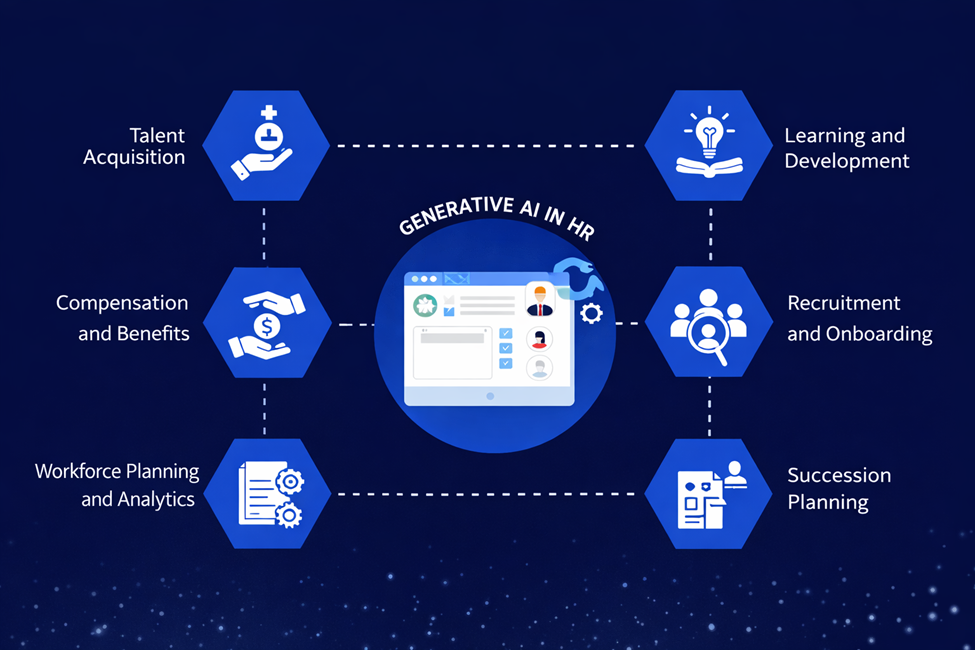
Core Use Cases of Generative AI Across HR Functions
Talent Acquisition and Recruitment
Recruitment is one of the most impactful areas for generative AI adoption. AI-powered HR systems can analyze thousands of resumes, match candidates against role requirements, and generate shortlists in a fraction of the time required by manual processes.
Generative AI can also:
- Create tailored job descriptions aligned with role competencies
- Draft personalized candidate outreach messages
- Provide unbiased screening insights based on skills and experience
This results in faster hiring cycles and improved candidate quality.
Employee Onboarding and Knowledge Access
Onboarding new hires often involves navigating policies, tools, and organizational knowledge spread across systems. Generative AI simplifies this by acting as an intelligent HR assistant.
AI-driven systems can:
- Answer employee questions in natural language
- Summarize policies and benefits documents
- Guide employees through onboarding workflows
This improves early employee experience while reducing HR support overhead.
Performance Management and Feedback Analysis
Performance reviews generate large volumes of qualitative data that are difficult to analyze consistently. Generative AI can synthesize feedback from multiple sources and generate structured performance summaries.
HR teams benefit from:
- More objective performance insights
- Early identification of skill gaps and high-potential employees
- Data-backed development recommendations
This enables more transparent and continuous performance management.
Learning and Development Planning
By analyzing performance data, role requirements, and career progression patterns, generative AI can recommend personalized learning paths for employees.
These insights help organizations:
- Align training investments with business goals
- Support internal mobility and upskilling initiatives
- Improve employee retention through career growth opportunities
Enhancing HR Decision-Making With Enterprise AI Platforms
While point solutions address individual HR tasks, enterprise-grade generative AI platforms bring the most value by unifying data, workflows, and intelligence across HR operations.
Platforms like ZBrain™ are designed to integrate with existing HR systems, securely process enterprise data, and apply generative AI in a controlled, scalable manner. By orchestrating AI agents and workflows, HR leaders gain real-time visibility into workforce trends and can respond proactively to organizational needs.
To understand the broader capabilities of such platforms, organizations can explore ZBrain as a foundation for building customized, AI-driven HR solutions.
Key Benefits of Generative AI in HR Operations
Operational Efficiency at Scale
Generative AI reduces manual workloads by automating repetitive HR tasks, allowing teams to focus on strategic initiatives such as talent development and workforce planning.
Improved Accuracy and Consistency
AI-generated insights are based on standardized logic and comprehensive data analysis, reducing inconsistencies and human bias in HR decisions.
Enhanced Employee Experience
From instant query resolution to personalized learning recommendations, generative AI helps create a more responsive and engaging HR environment.
Data-Driven Strategic HR
By transforming raw HR data into actionable intelligence, generative AI empowers HR leaders to contribute directly to business strategy and long-term growth.
The Future of HR Is Generative and Intelligent
As organizations continue to evolve in an increasingly digital and competitive landscape, HR operations must become more agile, intelligent, and employee-centric. Generative AI is not just a technological upgrade—it represents a strategic shift in how HR functions deliver value.
By adopting secure, enterprise-ready platforms and embedding generative AI into core HR workflows, organizations can build resilient, future-ready HR operations that support both business objectives and workforce well-being.