Key Takeaways
- SASE integrates networking and security into a unified, cloud-native service.
- It enhances security by implementing Zero Trust principles and consolidating security functions.
- SASE improves network performance by optimizing connectivity and reducing latency.
- Adoption of SASE is driven by the rise of remote work and cloud services.
- Future trends include increased AI integration and support for IoT and edge computing.
Table of Contents
- Introduction
- Core Components of SASE
- Enhancing Security with Zero Trust
- Optimizing Network Performance
- Drivers of SASE Adoption
- Future Trends in SASE
- Conclusion
The demands on modern networks are rapidly increasing as organizations expand their digital infrastructures to meet the challenges of a global, mobile workforce and growing cloud adoption. Traditional network architectures are struggling to keep pace, often compromising between security, usability, and speed. As a result, businesses are increasingly turning to the Secure Access Service Edge SASE security architecture to simplify network management while elevating security standards.
SASE integrates networking and security into a unified cloud service, simplifying operations and enhancing visibility for organizations. This shift is vital to ensuring secure, rapid access to applications in a competitive digital landscape. By reducing operational complexity, SASE enables proactive cybersecurity measures that protect users and resources beyond traditional corporate boundaries. As digital transformation accelerates, SASE’s architecture supports flexibility and scalability, positioning enterprises to guard against sophisticated cyber threats while delivering efficient networks. This transition represents a fundamental change in network and security strategies, crucial for businesses aiming to maintain a competitive advantage in the evolving digital realm.

Core Components of SASE
At its core, the SASE model converges multiple networking and security technologies to create a holistic, cloud-native, scalable solution. The major components that define the SASE architecture include:
- Software-Defined Wide Area Networking (SD-WAN): Delivers flexible, policy-driven routing for application traffic across diverse network connections, ensuring optimal performance for users regardless of location.
- Secure Web Gateway (SWG): Protects users from malicious internet content and blocks unsafe websites and downloads in line with organizational security policies.
- Cloud Access Security Broker (CASB): Offers critical visibility and control over data and user activity within cloud services, addressing compliance and data loss prevention requirements.
- Zero Trust Network Access (ZTNA): Replaces traditional VPNs by verifying user identities and device security at a granular level, granting access only to pre-approved resources.
- Firewall as a Service (FWaaS): Moves firewall controls to the cloud for network-based threat protection and centralized, unified policy enforcement.
Integrating these components reduces the complexity of legacy point solutions and enables organizations to easily enforce security across global networks as business needs evolve.
Enhancing Security with Zero Trust
Legacy security models once deemed internal network traffic as inherently trustworthy, leading to challenges as attackers exploited these assumptions. The Zero Trust philosophy, central to SASE, addresses these gaps by imposing continual validation for users, devices, and applications. No entity is trusted blindly; verification is required for every connection attempt. This continuous authentication and authorization limit the risk of compromised credentials leading to significant breaches or permitting lateral threat movement within the network.
Zero Trust within SASE not only enhances security against external attackers but also mitigates the risks posed by insider threats. Policies can be tailored based on user role, device posture, location, and the sensitivity of the application or data, enabling highly granular access management. As SASE policies are consistently applied at the cloud edge, this approach scales across distributed environments, including remote workers and branch offices. According to IBM Security’s research, organizations that adopt Zero Trust strategies experience significantly lower financial impacts from security incidents.
read more : https://networthflo.com/
Optimizing Network Performance
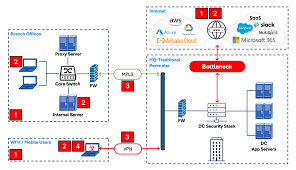
While security is paramount, user experience must not be neglected; SASE achieves both by utilizing SD-WAN intelligence for dynamic traffic management. Rather than channeling all user data through a single on-premises concentrator, traffic is routed directly to cloud applications and services through the most efficient path. This approach eliminates traditional bottlenecks and reduces latency, especially for globally distributed teams reliant on Software as a Service (SaaS).
Cloud-delivered security decreases the backhaul of traffic to centralized data centers and allows organizations to easily scale protection as they add new locations or users. Delivering services at the network edge ensures that security controls are applied closer to the user, increasing responsiveness and maintaining reliable performance even as workloads fluctuate.
Drivers of SASE Adoption
Major shifts in organizational IT strategies are fueling rapid SASE adoption. The expanded role of cloud platforms in daily operations, coupled with an unprecedented shift towards hybrid and remote work, has rendered perimeter-based security approaches obsolete. As employees and resources become more distributed, IT teams require solutions that can provide strong security and consistently positive user experiences, no matter where their people or data live.
SASE solutions also offer the flexibility necessary for cloud-first organizations, replacing the need for multiple legacy appliances with a cloud-native stack that can adapt in real time to business requirements. Integrating cloud-delivered security and networking can help organizations decrease their attack surfaces while making it easier to manage policy enforcement across locations.
Future Trends in SASE
- AI and Automation: The emergence of AI and machine learning capabilities in SASE platforms is accelerating both security and efficiency. AI-powered analytics can automatically detect threat patterns across massive datasets, enabling organizations to respond more quickly to new cyber risks. Automation further streamlines operations, reducing human error and allowing IT teams to focus on strategic initiatives rather than day-to-day maintenance tasks.
- Zero Trust Evolution: As attackers grow more sophisticated, SASE vendors are introducing granular, context-aware identity controls. These advancements enhance Zero Trust architectures, delivering consistent access protection across cloud, edge, and on-premises environments. Zero Trust is quickly becoming a mainstay principle for future-proof network security frameworks.
- Integration with IoT and Edge Computing: SASE platforms are evolving to cover new network edges created by IoT devices and edge computing resources. Future solutions will need to secure devices and connections far beyond traditional branch offices or main data centers, pushing security closer to users and devices wherever they reside.
Conclusion
SASE marks a pivotal shift in how enterprises approach network and security architectures. By converging networking and security functions into a single, flexible cloud-native model, organizations gain hardened defenses, smoother user experiences, and the adaptability needed for the future of work. As businesses continue adopting new cloud and digital strategies, understanding and embracing SASE will be essential for maintaining a competitive edge in secure networking.